Console Gaming History Adventure: 1983
I can’t believe I’m saying this, but I did it. I really, actually did it!
I have now consumed such an unreasonable, incredible number of very old games that I feel like I might just explode at any moment, but after a year and a half of forcing them down and being a champ, I have actually managed to complete the most infamous year in the entire history of console gaming, 1983! And that means it’s finally, finally time for another article in my Console Gaming History Adventure series to follow up the previous article on 1982! The moment is absolutely surreal!
1983 wasn’t just the year of the Great Video Game Crash of 1983; it was also a time of an unbelievably massive spike in console game releases that caused the crash. That left me with a truly insane number of games to get through – well over 500, compared with the roughly 300 I had to deal with in 1982. And that doesn’t count all the arcade games, as the arcade industry was also very much alive and well at the time! In total, I had 726 titles to get through! I don’t know how I did it, but I did! I really did!
As for what exactly happened with the crash, researching that has turned out to be really hard for two reasons: First off, all the sources I can find are, predictably, super Americentric, failing to give me a good international perspective on the crash. The crash was an international phenomenon, affecting console gamers and the businesses that catered to them in virtually all regions where console gaming existed. American dominance of the gaming industry meant that it had to be. But different places were affected in different ways. In Europe for example, a thriftier spending culture meant there wasn’t all this hype around console gaming to begin with, so it wasn’t anywhere near as painful or dramatic when the industry suddenly died off. It did still die off! My playlist of games for later years shows a sudden loss of European releases too! But it’s unclear exactly what this would have been like for European consumers, game developers, and retailers and what they would have seen and experienced. What I can say is that regardless of where you lived in the world, as a gamer, you wouldn’t realize anything bad had actually happened yet – not this year. At least in the USA, you would have just noticed you were able to get awesome bargains on heaps and heaps of available cartridges at stores for some mysterious reason… 😬
The other problem is that my own original research is badly contradicting universally agreed upon perspectives on the crash – specifically, when it comes to game quality. As the narrative goes, all these new companies flooding the gaming market were inexperienced and too focused on making money, with no real passion for designing and producing video games as an art. So the industry was flooded with bland, buggy, unoriginal, poorly balanced, and overall terrible quality “shovelware”. This is supposed to have been key to destroying consumer confidence in video games, causing the crash.
But I’ve now played virtually all the console games released in 1983 for myself and I’m just not seeing what I’m supposed to be seeing! Were there some truly awful games? Absolutely! But there were truly awful games in 1982 too, as well as in 1981, 1980, 1979, etc.. Since I began this project with the year 1976, I have noticed that each year has been better than the last when you average things across all the games released in a given year. Graphics have become steadily more refined and well-polished even on the same hardware. Gameplay balance and design has gotten continually better as it became clearer what worked and what didn’t. Games have gone from being mindless rip-offs of arcade titles to being a rich breeding ground for innovation in their own right. The artistic merit of games is still not great, but it’s gotten so much better! I remember when I was so impressed by the stylistic charm of that Human Cannonball game because it was so anachronistically good for the time. Such a thing doesn’t impress me anymore because it’s become much more commonplace as my adventures have continued! I can even point to a few titles this year that invoked a significant emotional response in a way I was not expecting. Yes, it’s true that titles from Atari, Sega, and Activision tend to be better quality than the ones made by Purina or Quaker Oats. But the long journey through all these releases has not been anywhere near as painful as what I was promised it would be, and while the sheer volume of stuff to get through really tired me out, I was ultimately generating at least several times more hedons per game on average than I did with 1982. So I really don’t get where this idea that this stuff was all garbage comes from. 🤷🏻♀️
What does seem clear at least is the role that the blossoming home computing industry had in the crash. A competitive price war had driven computers down in cost to the point where they became more affordable to families, and they were also growing more capable. The Commodore 64 had 64 times as much RAM as the ColecoVision and a wayy more powerful graphics chip, enabling immersive worlds and a far more complex, involved experience for gaming. It’s not a surprise that at some point, people started asking themselves what the point was of a gaming console when computers could do a better job at playing games for the same cost. And they could also do a lot more than just play games – serious business like Word Processing, Spreadsheets, and collecting terrible ASCII porn images from BBSs! I’ve read accounts online from humans who were in the thick of the experience at the time, talking about how they were selling their gaming consoles and using the money to buy computers instead! 🫢
Maybe that’s why Japan was so well protected from the crash. Computers weren’t nearly as affordable and accessible there, which made them less of a threat to game consoles. And Japan largely had their own consoles and their own games, so the economic black hole happening over in the US would have less of a pull on them. While the rest of the developed world saw its console game industry wither and die, 1983 was actually a massive renaissance for Japan – by far the biggest boost to console gaming in their entire history! This year of death was also a year of new life – the start of a whole new generation of console gaming – Console Generation 3! And I can’t wait to talk about it!
New Consoles
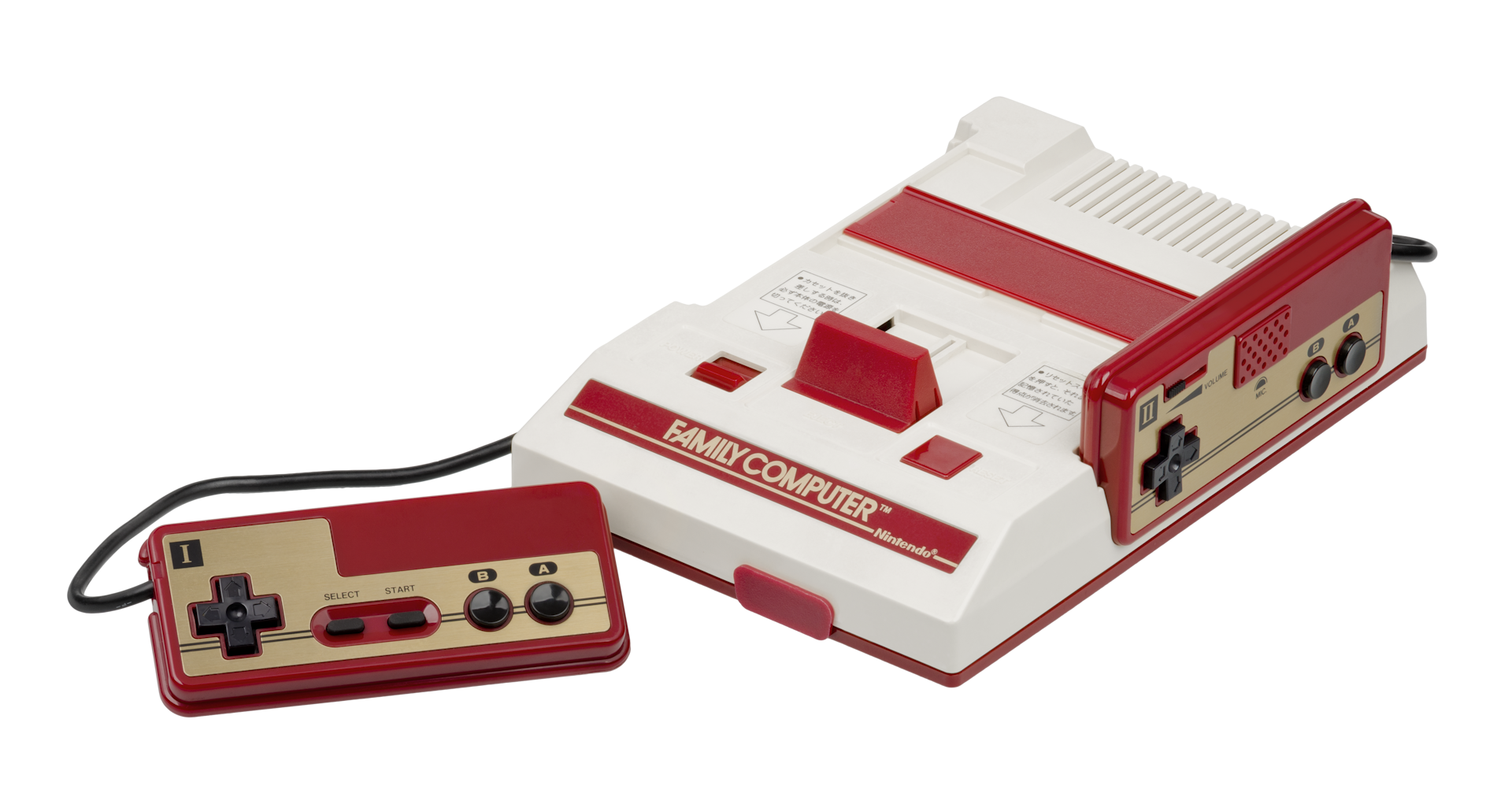 The Japanese-only Nintendo Home Cassette Type Video Game: Family Computer, or Nintendo Famicom for short, was not Nintendo’s first foray into the home console market. They’d produced the Color TV-Game series of Generation 1 consoles from 1977 to 1980, as well as the Game & Watch series of portable, single game devices we talked about in an earlier article. But the Famicom was still a truly revolutionary system that marked a major turning point in the history of console gaming. As a more portable, affordable adaptation of the arcade hardware that had powered Nintendo’s Donkey Kong, the Famicom was actually mostly on par with a large percentage of arcade machines still being released in 1983, if you ignore resolution and audio quality. It offered similar graphics of a similar frame rate and color depth, and to show off its incredible power, the console debuted with ports of three arcade games only a year or two old that were perfect recreations of the originals! 🤯
It’s hard to overstate what a big deal this was. Famicom games might look primitive by today’s standards, but at least they are uniformly primitive – able to maintain a consistent look across the entire screen. Unlike with Generation 2 consoles like the Atari 2600 or even the ColecoVision, the Famicom has enough video memory and other allocated resources available that there’s no need to focus detail only in certain spots of the display. Every sprite on the screen got to have up to 3 different colors, plus transparency, whether that sprite belonged to the all-important player character or a simple bat flying overhead. Backgrounds could be fully detailed and immersive, with no need to revert to simple rectangles or pixel doubled graphics to save memory. The system’s audio was finally good enough that background music could actually be nice to listen to, which quickly lead to it becoming commonplace among games. Smooth, decent movement of the game “camera” across a landscape was also finally made possible thanks to specific hardware support for background scrolling – a signature claim to fame of the system. While games can always look better, it was the Famicom that finally allowed for a mature, complete presentation for a video game scene.
But it wasn’t just the Famicom’s raw power that shook the industry. It was also the way in which it set new standards for console design. The Nintendo Famicom marked the birth of the modern gamepad, replacing the cumbersome numeric keypad centric “handset” controllers of later Generation 2 consoles. Gamepads are designed to be comfortable and ergonomic, without the need to awkwardly move your hands all over the place to operate them, enabling them to serve more effectively as an unconscious extension of your nervous system into the game world! The number of buttons was also interesting. The single button joystick of the Atari 2600 and Magnavox Odyssey² had proven to be severely crippling for game variety, but massive grids of buttons such as with the VC-4000 or the CreatiVision were ridiculously complex. Nintendo settled on just two action buttons, labeled “A” and “B”, and replaced the numeric keypad design with two simple, elegant “Start” and “Select” buttons for making menu selections before gameplay started. I chose console games to play over PC games for a reason, and I have absolutely hated how all these Generation 2 handset controllers, with so many buttons, made it so hard to quickly figure out how to play a game, so for me, this is a welcome change – a perfect balance between sophistication and simplicity! The whole design of the gamepad was directly based on what had been forming in Game and Watches over the past few years, particularly the cross-shaped directional pad / D-pad that was taken from the design of the original Donkey Kong for the Game and Watch.
The Famicom was incredibly successful and long-lasting, so expect its games to be a permanent part of the lineup for the remainder of these articles, however long I can manage to keep going with this! Well into the 1990s, long after Generation 4 had taken over the gaming market, the Famicom, with its simpler but nevertheless mature and complete graphics, continued to exist as a low budget alternative. Nintendo actually continued to manufacture and sell brand new Famicom consoles in Japan until 2003!
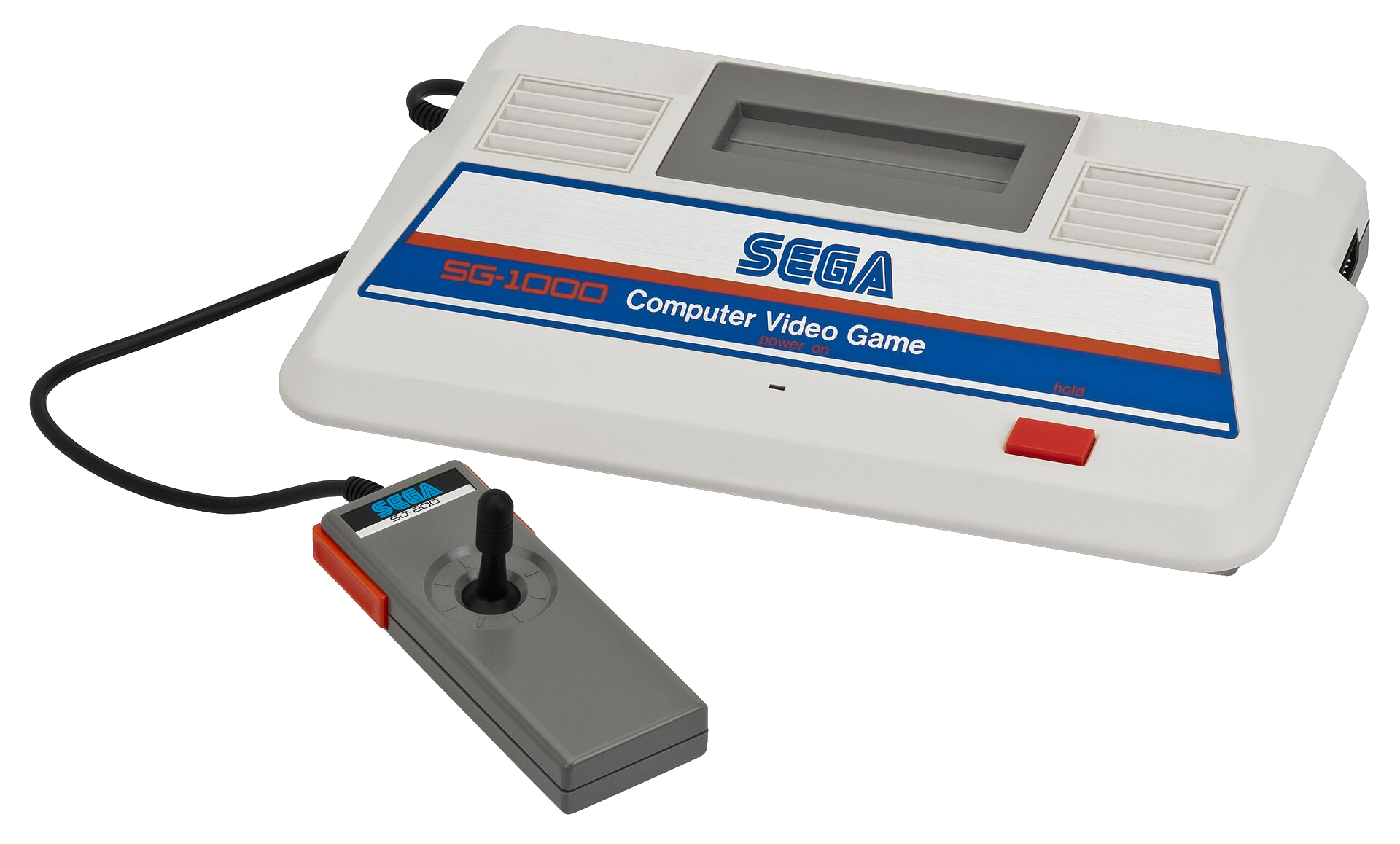 The Famicom would certainly come to face its share of serious competition across its lifespan, but not this year. 😐 On the exact same day that Nintendo released the Famicom, arcade manufacturing rival Sega (short for “Service Games”) released the Sega SG-1000 as their response. The SG-1000 used standard parts and chips, ending up sharing so much with the ColecoVision that the only two things preventing the two systems from running the same games were the cartridge slot shapes and differently sized firmware that required games to access a different range of memory addresses. Their sound, memory, processing, and graphical capabilities were identical. The ColecoVision was a Generation 2 console that the Famicom was specifically designed to outclass, so unfortunately for Sega, making an almost-clone of the ColecoVision was simply not good enough for duking it out with Nintendo. This disappointment for Sega marked the beginning of the famous rivalry of the console world between Sega and Nintendo that would dominate the next 20 years of console gaming history!
Sega’s first console wasn’t a total failure though. A common misconception about the SG-1000 is that it was limited exclusively to Japan. It wasn’t – it’s just that Americentric thinking equates “never released in the USA” to “Japan-only”. While the Famicom’s presence in Japan doomed the SG-1000 to commercial failure there, Sega was able to eke out an existence internationally, especially in Oceania, with some limited presence in Europe. This strategy of establishing a loyal customer base in international markets before Nintendo could get to them would serve Sega well in the long-running console war between the two titans that would follow!
Like with the Famicom, the SG-1000’s controller contained only two action buttons. But it was otherwise more conventional in that it used a joystick instead of a D-pad and was shaped much like a numeric handset controller, even if it didn’t include the actual numeric keypad of one. Sega would later update the console to include an all-new controller design that much more strongly resembled the Famicom’s. Both versions of the controller however had no equivalent of Nintendo’s Start and Select buttons. Instead, the two action buttons were also used to make menu selections.
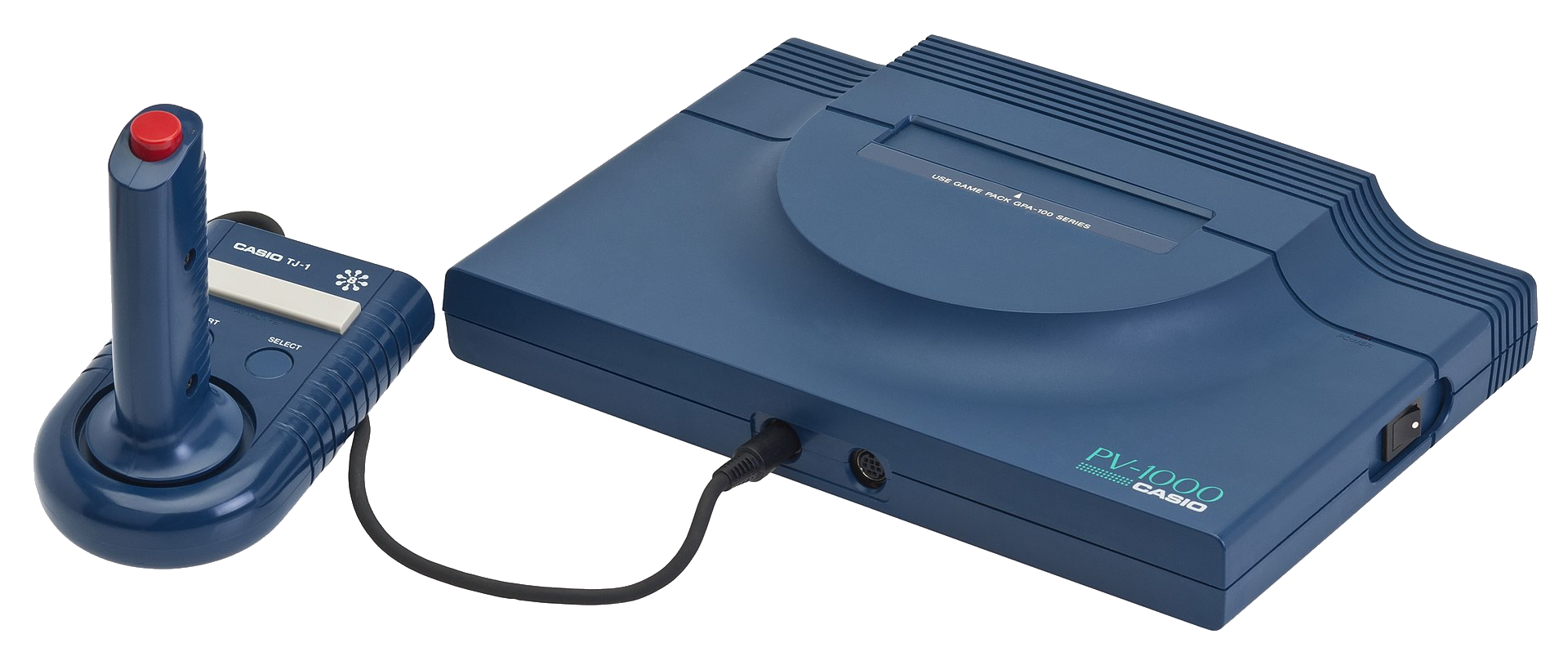 Not everyone up against the Famicom could boast of the same fortunes. The Casio PV-1000, a Japanese console released several months after the SG-1000 and Famicom, was exactly that kind of non-success story. On the market for only a few weeks, it was quickly pulled because of poor sales. Maybe that’s just as well, because the color limitations of this thing made its games look really garish and ugly. Maybe if it had lasted longer it could have at least had some interesting content made for it. As it stands, the only games to ever support it are all straight arcade clones, looking very much like their originals, only reimagined in gaudy, limited, eye-bleeding reds and greens. 😕
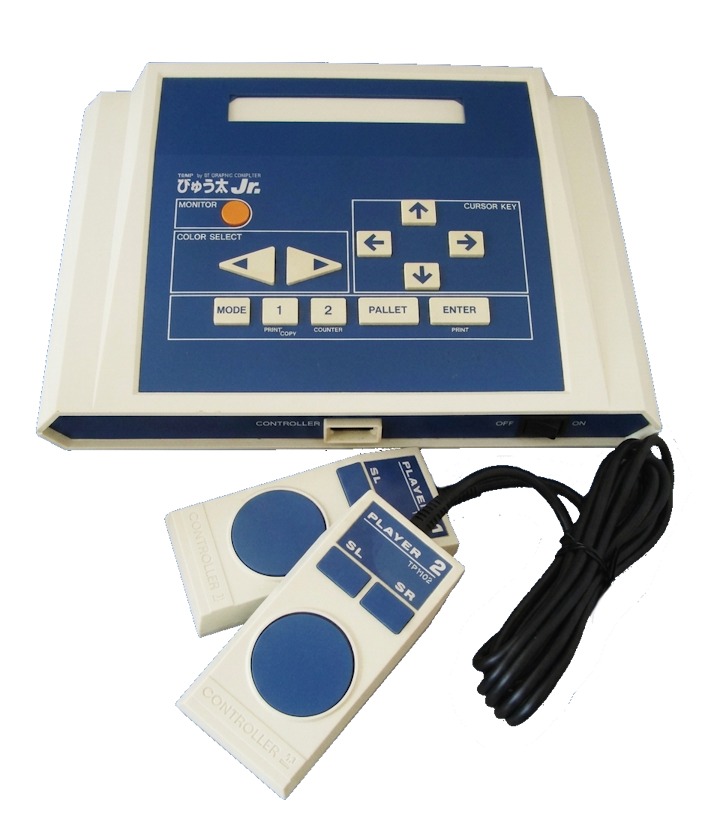 (NO ACCESS) The success and simplicity of the Famicom was, interestingly enough, also a threat to home computers – exactly the opposite of what was happening at the same time in the Western world since computers in Japan remained expensive and inaccessible and the Famicom held up relatively better to home computer graphical capabilities. The Tomy Toy company, which sold a youth-centric home computer at the time called the ぴゅう太 / Pyūta (English: ‘Puter), decided to fight back with the release of the ぴゅう太 Jr. / Pyūta Jr., a scaled down, low-cost version of the Pyūta that removed the keyboard and other functionality not needed simply for playing games. The product was no big success, but Tomy insisted on sticking it out for two years before finally giving up on both their computer and its consolified little brother in 1985 after releasing 26 cartridges compatible with both systems.
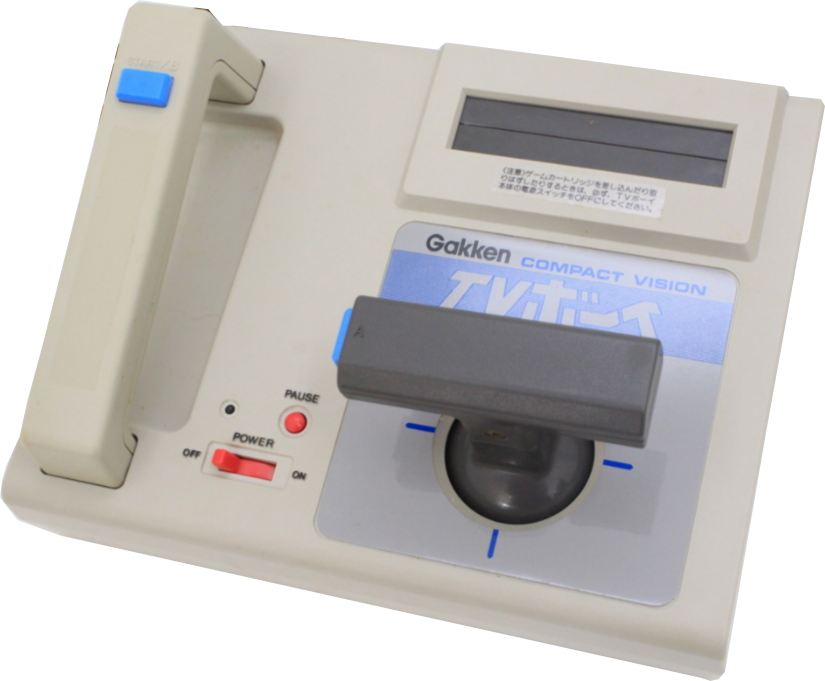 (NO ACCESS) The Gakken Compact Vision TV Boy has what is by far the weirdest controller I have ever seen – if you can even call it a controller, since it’s in two pieces and is built into the console itself. This fascinating freak of non-nature debuted in Japan several months after the release of the SG-1000 and Famicom. It seems to be classified as a Generation 2 console rather than Generation 3 like all the above-mentioned ones, probably because it was originally intended to compete with the Generation 2 Epoch Cassette Vision that had long dominated the Japanese console market before the Famicom existed. Maybe if Gakken had managed to release this thing a year earlier, it would have been able to do that, but it was simply no match for the Generation 3 consoles that ended up preceding it. It died a quick death after only 6 games were made for it!
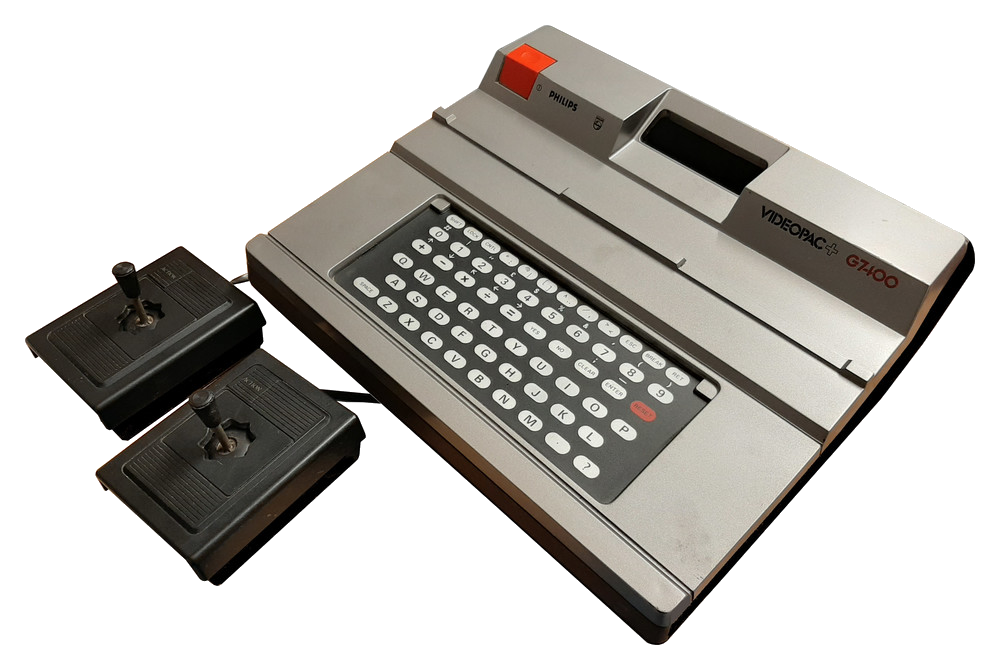 Not that all of 1983’s miserable failures were limited to Japan – at least if you consider the Magnavox Odyssey³ to have succeeded enough to have even earned the right to be called a failure. 😬 Working prototypes of the system were built and it was even demonstrated at CES in 1983, but thanks to the Great Video Game Crash, it was never actually released. Its European counterpart did just barely make it to market though, branded as the “Philips Videopac+ G7400”, and it’s this counterpart that is pictured here. Since that’s the only version that was ever sold, it’s the name most sources will use to refer to the console in general. I prefer “Odyssey³” though, both for the sake of consistency with how I chose to use American branding to refer to its American Odyssey² predecessor and because this would be consistent with how the company saw things before canceling the project (the Odyssey²’s European name had been “Philips Videopac G7000”).
The Odyssey³ was capable of running Odyssey² games, and along with this, a new feature was added to the Odyssey² format that allowed for special background art to appear only when the games were run on an Odyssey³. The Odyssey³ then also ran its own format with higher resolution graphics that could not run at all on an Odyssey². I’m not sure how interesting this would have turned out to be had the concept been allowed to take off. With the death of the Fairchild Channel F and with the extensive hacks developed over time to improve the Atari 2600’s graphical capabilities, the Odyssey² had become by far the most wretchedly hideous console around! 🙁 I don’t think such modest improvements would have allowed the thing to be competitive, particularly with how characteristically crude, complicated, and just plain unfun most of the game lineup continued to be. I guess we’ll never know because the Crash meant that the console’s existence in Europe was brief and fleeting, and the whole thing burned up into nothing pretty fast. 😶
Returning Consoles
1983 may have been the start of Generation 3, but it was only the start! All of the Generation 3 consoles listed above came out in the later half of the year and it takes time after a console hits the scene for releases to really start revving up. Generation 2, meanwhile, was a gigantic, yet-to-pop bubble for much of the year and even after the Crash officially happened, inertia from prior enthusiasm would keep the insane torrent of unwanted releases coming well into 1984 before things finally petered out. It all means that Generation 3 makes up only the tiniest sliver of 1983’s lineup of new console games. We are still well within Generation 2 territory here!
Now that the ColecoVision and Atari 5200 are a year old, we finally have a good number of games coming out for them, and they showed up frequently in my lineup. With more opportunity to see the ColecoVision at work, I became more aware of its limitations as a platform. In particular, I came to notice that while detailed sprites on par with the Famicom were possible, they’d usually be limited only to the player character, if they appeared at all. Most sprites continued to be 1-bit color – blobby, blocky silhouettes that often required you to check the manual if you wanted to know what they were actually supposed to be. Apparently the reason for this was that multicolored sprites were basically just multiple sprites of different colors stacked on top of each other, moving together and appearing as one sprite. Given the really harsh limit to how many sprites could appear on the screen at once, this meant the technique could only be used when it was particularly important. The ColecoVision’s strict color limitations also mean that unlike the Famicom, it’s not really possible to have any kind of “shading” on objects. Everything is flat, solid colors in an MS-Paint-like style. With so few possible colors in the ColecoVision’s pallet, you quickly become familiar with them all and that makes the coloring of specific objects feel less meaningful. 🫤
The Atari 5200 looked noticeably worse than the ColecoVision. It supposedly has vastly superior color capabilities, but if so, I didn’t see the games this year take advantage of that like they could have. Mostly they reminded me of very old, beepy MS-DOS games. Generally, there was enough detail in the ColecoVision games for important characters to actually have faces – not so for the Atari 5200 games.
The Intellivison seemed to be doing quite well too. Fortunately, by this time, people had finally figured out that programming the number keys with actual game functions made things much too complicated, so there are mercifully few titles that use the numbers for anything other than making menu selections before actual gameplay starts.
The Atari 2600 continued to dominate this year but something really cool was happening to the platform! All those tricks to improve detail were adding up, and things didn’t look anywhere near so awful anymore! I even came across a few cases where I could point to a particularly beautiful Atari 2600 game looking better than a particularly ugly ColecoVision/SG-1000 game, which is absolutely amazing!
A single game being ported to multiple systems at once became a much more common occurrence this year, which was an awesome chance for me to compare the graphical capabilities of the different systems to make the conclusions I made above!
The other surviving Generation 2 consoles, including the Astrocade, Magnavox Odyssey², Epoch Cassette Vision, VTech CreatiVision, Emerson Arcadia 2001, and Vectrex continued to have new games this year, but the output had been reduced to a tiny trickle for all of these. It’s obvious that even before the actual crash hit, such an incredibly overcrowded market was causing a lot of grief for the little guys and I bet a lot of them were already regretting getting invested in all this. Most of them would either already be gone by or go away in 1984. Obviously the introduction of the Famicom, which was shockingly affordable, meant the very primitive and very Japanese Epoch Cassette Vision was completely screwed! 😢
Noteworthy Games
With the sheer volume of games for me to choose from, I could easily have selected 50+ games for this list, but I think a hard limit of 25 is a good idea to keep the page from getting too long! 😳 With how the game market has matured by this point, with plenty of releases each year to select from, I’m probably going to stick to exactly 25 games per year going forward – we’ll see!
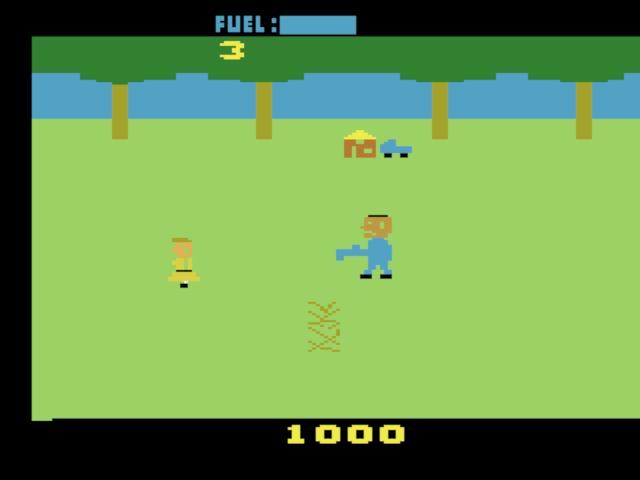 I know with the reputation this year has that readers are going to expect some descriptions of some truly awful games, and I am not about to disappoint! To start with a bang, we can go over The Texas Chainsaw Massacre for the Atari 2600, which is based on the horror movie “The Texas Chain Saw Massacre”, which I have not seen. The game has you playing Leatherface from the movie, chasing after innocent women with your chainsaw and killing them for meat! Given human culture’s weird oversensitivity to violence in video games, it’s not hard to imagine why such a tasteless premise was received so poorly. 😬
But just because the game’s worst aspect is the plot and theme doesn’t mean the gameplay is all that great either. 😐 The idea is that you have limited chainsaw fuel for killing people that drains continually even if you are only just standing there holding it, but especially when you use it so you want to use your time and action button as efficiently as possible to get the highest score. There to get in your way are several obstacles that show up on the screen, such as fences and bramble bushes. If you accidentally touch them, you’ll get stuck, slowing you down and requiring you to waste chainsaw fuel freeing yourself. That part isn’t so bad, and you can learn to move efficiently with practice even given the incredibly clunky feel of moving Leatherface around. The problem are the victims themselves, who run around you in an unpredictable way that makes successfully killing them feel more like a game of random chance than skill.
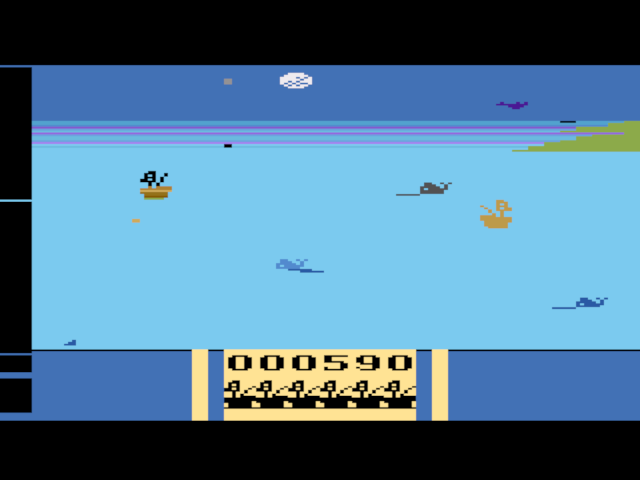 Then we have Treasure Island, also for the Atari 2600. I was particularly excited when I saw this one in the list because I absolutely love pirate-themed stuff! Then I went to play it and umm… I guess it is pirate themed… I guess. I mean, you have an island in the distance and an ocean and a pirate ship, right? And some incredibly strange, weird, off-beat music that sounds kinda piratey maybe? But you also seem to have a lot of other stuff going on – as in, too much other stuff going on! Right at the start, the map is utter chaos, with bullets, vessels, and creatures filling the screen. You have no idea what’s considered hostile and what isn’t. You can apparently fire cannon balls, but it’s not clear how – sometimes holding the fire button seems to hurl a machine gun barrage of them all over the place and sometimes it does nothing. Trying to move your ship sometimes causes the gun to aim up and down instead.
I’m not sure how you are actually supposed to control your ship, or how you are actually supposed to then use it to play this game properly, or if there even is a valid answer to either of those two questions. This title didn’t come with any sort of manual, and it’s designed in such a non-obvious way that I’m left super confused. What I do know is that however this game is meant to be played, if you can just cluelessly spam buttons and still have no hope of ever running out of lives no matter how long you play, it’s clearly too easy of a game. It’s not that you don’t die – I haven’t figured out exactly what kills you. But you gain new lives at about 10 times the rate you lose them – I haven’t figured out what actually causes you to gain lives either. This game is bedlam incarnate, and not even in a funny or amusing way (maybe). At first I wondered if it was an unfinished prototype, but no – this is the final game, boxed and sold. I just don’t know what to make of it other than to say if I had bought this for my Atari 2600 back in the day, I would definitely have felt ripped off! 😠
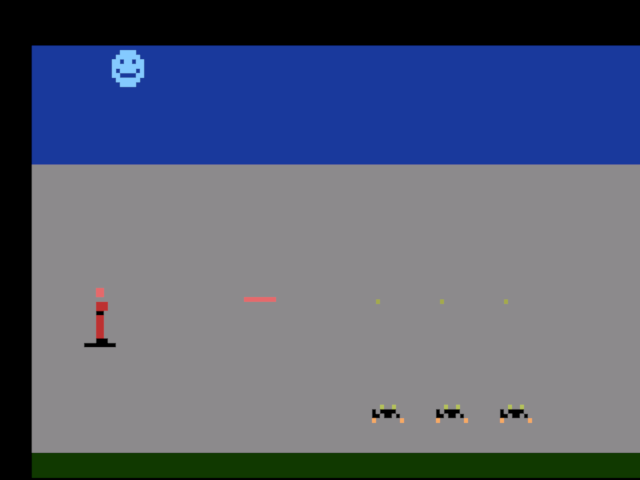 When it comes to the most commonly cited terrible games released this year though, I think people are actually being pretty unfair in so brutally ripping into them! Probably the most infamous games of the year are a trio released by a company called Mythicon. All three are for the Atari 2600, and all three heavily reuse code and gameplay elements from each other. They are Sorcerer (pictured), “Star Fox” (no relation to the later Nintendo franchise), and “Fire Fly”.
Are these games bad? Well, they certainly aren’t great, but you get what you pay for. 🤷🏻♀️ In 1983, games were still a lot more expensive than they are today. The average Atari 2600 cartridge, at least in the USA, sold for about 35USD at the time, which would be 117.76USD in 2026! Mythicon offered an alternative for financially conscious people who didn’t want to spend so much, with their cheap games selling for only 9.95USD, which would be 33.48USD in 2026. Selling the game for so much less money naturally means they would not be able to afford to spend so much on development time or expertise. It explains why the three games reuse so much in the way of code and gameplay elements and why all three games feel rushed, sloppy, and unsophisticated. That doesn’t mean it’s impossible to get fun out of them! They are still perfectly playable and I don’t think they would have disappointed anyone with reasonable expectations to go with their spending preferences. Really, I actually think the music for Sorcerer is particularly fantastic, sounding thick, full, and emotional even on such a primitive console, produced at a time when original compositions in video games were incredibly rare. It sounds like the composer was particularly proud of the piece, and he should be! If you head to the toy store and dig up the most miserably cheap thing you can out of the bargain bin, then throw a big temper tantrum when it turns out not to be the Mona Lisa, maybe you are the one who is the source of the problem! 🤠
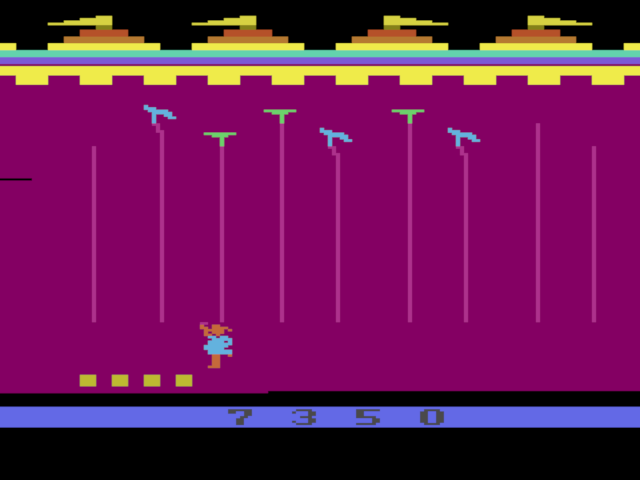 Another game commonly blamed for the Crash is Dishaster (a portmanteau of “Dish” and “Disaster”) for the Atari 2600. In Dishaster, you play a little girl balancing plates on poles, which start to wobble if they are left unattended. If one is neglected for too long, it will fall. If you then fail to catch it, it will shatter on the ground, and you will lose a life.
While I still wouldn’t exactly give this game a 10 out of 10 and didn’t feel compelled to play it longer than I had to with hundreds of other games waiting for me, I really feel like it’s been unfairly condemned as well! People complain the game is lacking in scenery and detail, but look at the screenshot for yourself! There is plenty of scenery at the top of the screen to contribute to the atmosphere, and as much detail in the actual gameplay area as can be expected on a console that was so incredibly primitive even by the standards of the day. 🤷🏻♀️ Another complaint is how short and repetitive the looping background music is, lasting only about 20 seconds before starting over. I’d point out that the background music of Donkey Kong – an incredibly famous and revered arcade game running on far superior hardware, lasted barely over a second before repeating! People also complain about Dishaster’s total lack of sound effects. Except, ummm… it actually did have sound effects, nearly all of which are for actions, such as walking and straightening poles, that would not produce any significant noise IRL! And it even manages to play all these unnecessary noises without interrupting the music, something most other games on much more powerful consoles such as the Game Boy would struggle with right up to the end of the century!
Critics seem to focus a lot on how straightening plates is too monotonous. Maybe if you don’t like the idea of balancing spinning plates on poles, you shouldn’t spend over 100USD in 2026 money on a game that is all about balancing plates on poles. I don’t like American football, not because it is bad to like it or because only stupid people like it, but simply because I just don’t like it. I am not unreasonable enough to go buy a Madden NFL game and then complain it is no good because I hate American football and find it boring. Instead, I recognize that that game exists for other people who will enjoy and appreciate what it is meant to be and I don’t argue it should be taken off the shelves just because it’s not my thing.
Probably the silliest grievance people have lodged against Dishaster though is when it comes to difficulty. They complain it is too easy. They point out that all you have to do is move in a pattern from left to right over and over and you can quickly learn to accumulate score forever without any remaining chance of failure, making the experience only suitable for small children. This is absolutely true, but only if you select the easiest of the four possible difficulties the game offers! This is what difficulty levels are supposed to be for in video games. If you find a game too easy, you can turn up the difficulty to resolve the problem and get the experience you want instead, leaving the easiest difficulty available as an invaluable option for simple practice and orientation. I can thank this absolutely ridiculous brand of criticism for why so many more modern games will have like 10 difficulty levels with even the easiest difficulty being impossible to play, all out of fear of making unreasonable chimpanzees like this mad. It drives me absolutely nuts! 😖
So no, I don’t think Dishaster is actually a bad game. It’s just thoroughly mediocre, like most everything you’ll find in most any form of media, from movies to books to TV shows to yes, even 1980s video games!
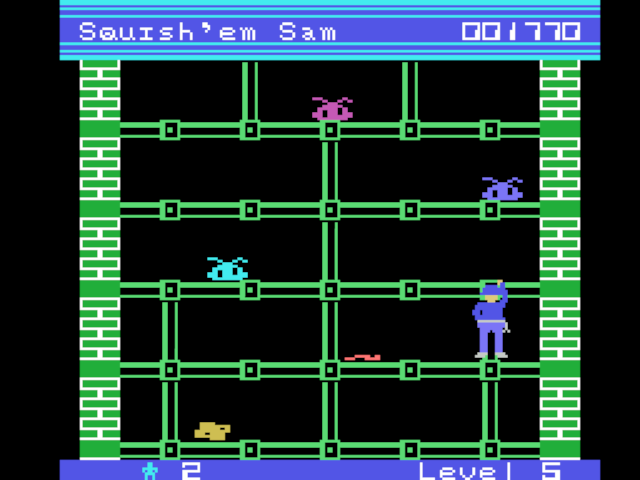 Really, I can point to a great deal more in the way of fantastic games in 1983’s lineup than I can to terrible ones. A great example is the addictive Squish’em Featuring Sam, inconsistently titled as Squish’em Sam in some places, which is apparently a ColecoVision port of a computer game that was normally just called “Squish’em”. In this game, you play Sam, who is climbing a series of pipes and dealing with baddies. Your only method of attack is to press either action button, which will cause Sam to raise his legs and then lower them again. It took me a while to figure out that you are supposed to raise his legs and then position yourself above an enemy before Sam lowers them in order to squish that enemy. You get it? 😅 This doesn’t kill the enemy, but it does give you score and renders them harmless for a limited period of time. Unfortunately, once they recover, they turn white and are now invulnerable! That’s not much of a problem though, because the point of the game is not to really stay in one spot for long, but to keep climbing upwards! There are a variety of different monsters to encounter and items to collect, and advancing to the next level changes the color of the structure you are climbing. The game is extremely fun, to the point where I’ve periodically gone back to it multiple times just to play some more rounds!
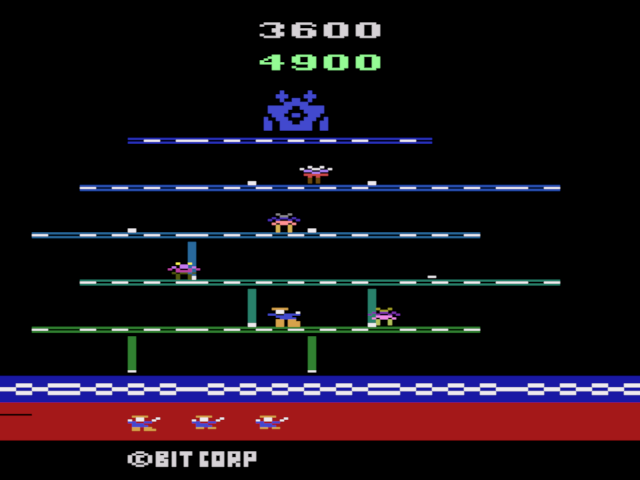 Another example of a fun and fantastic game is Open Sesame for the Atari 2600. Your goal is to activate all the climbable beams while avoiding the enemies. At least some of the beams must be activated to reach the top of the screen, but all beams must be activated in order to complete the level! There to help you are these dancing particles that occasionally travel their way down the level. Touching one will leave you temporarily invulnerable and able to kill the enemies by running into them! 👊🏻 The game is a delight to experience – the weird shuffling/dancing movement of the player character, complete with bizarre sound effects as he moves around, is particularly charming!
The American version of this game, which was published by a different company, is instead called I Want My Mommy. It substitutes the Arabian Nights theme of the original game with a backstory about a child having a nightmare, replacing some of the graphics and cutting out some of the possible level variations. I have no idea why they did this – I guess they thought it would sell better this way to Americans for some reason. 🤷🏻♀️
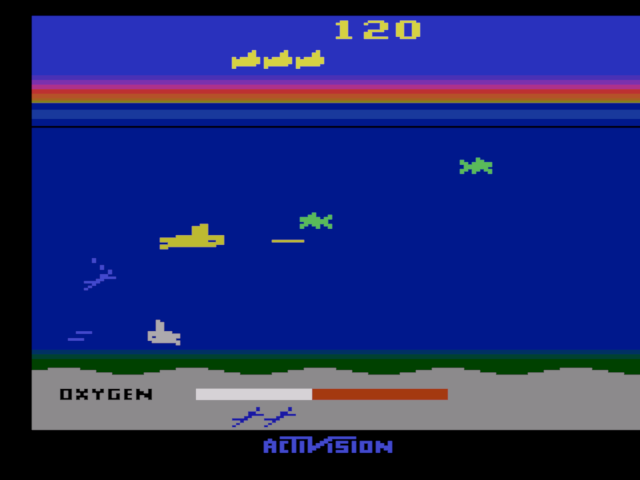 Then there is Seaquest for the Atari 2600, where you control a submarine and shoot things. Okay… so that’s maybe not the most original of concepts by itself… but at the same time you shoot stuff, you also need to rescue divers and return to the surface to refill your oxygen supply once you have enough of them! The game is just simple, addictive fun that is well balanced and will probably make you crave goldfish crackers if you play it long enough! The game is made by the same guy who did Megamania, one of the games I spotlighted last year (Steve Cartwright).
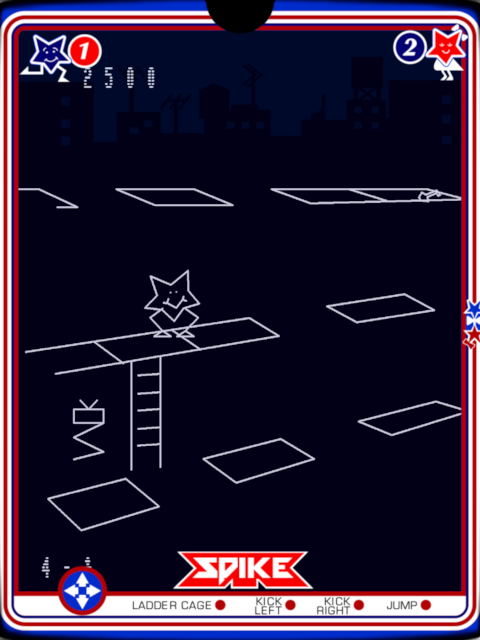 You can see just how dominant the Atari 2600 is this year, but along with the ColecoVision’s Squish’em Featuring Sam, we do have Spike for the Vectrex! While it takes a lot of pages out of Donkey Kong’s book, it has a lot of its own unique concepts too! In each level, you have to climb moving platforms in order to collect a key that makes a cage appear at the top of the screen you can jump to in order to finish the level. Climbing is made possible with a single ladder, which has to be moved manually by pressing the 1 button to teleport it between four pre-defined positions, something that also moves the cage around. After the first level, enemies you need to destroy with a kick are also introduced. I really like this game and it is easily my favorite game for the Vectrex! I’m really going to miss the experience of this amazing and unique console as part of this project. 😢
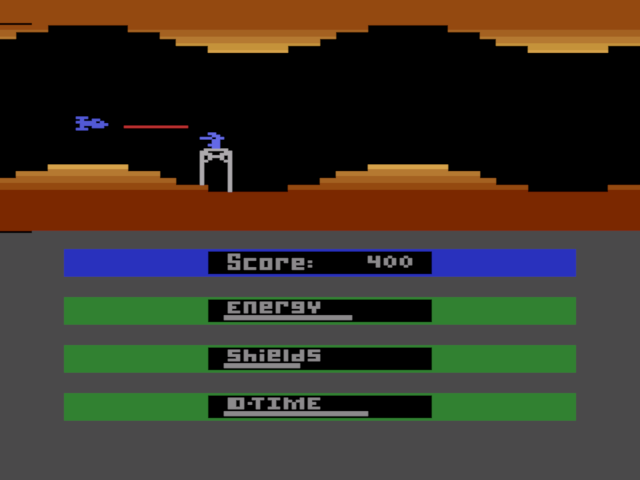 By far my favorite game out of all of the simple, arcade-style games this year is Laser Gates, once again for the Atari 2600. The game is a sideways oriented scrolling shooter that does have you defeating enemies that appear as you proceed down an endless tunnel. But it also has lots of laser beams for you to avoid, and destructible columns where you have to quickly punch a big enough hole in them to fly through! This is a game I played for hours, unable to easily bring myself to move on to the next game because I was just having so much fun with it! I highly recommend you give it a try!
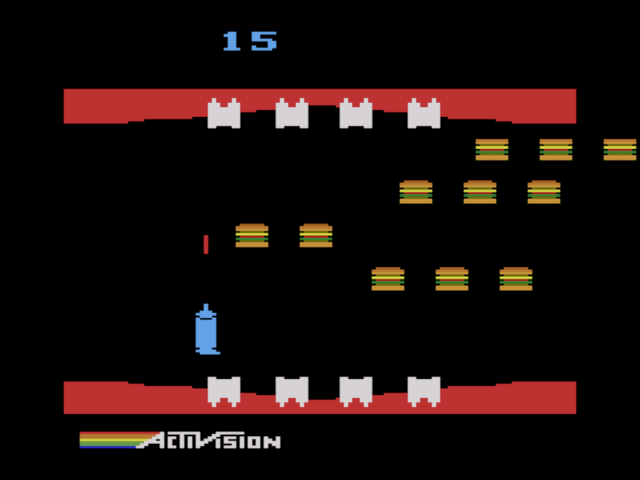 One of the most creative themes for a game this year comes from Plaque Attack for the Atari 2600, also by the same Steve Cartwright who brought us Megamania and Seaquest! In Plaque attack, you are a tube of toothpaste, there to protect teeth in a mouth from the evils of food, including burgers, fries, cherries, etc. You can fire up or down and have to shoot away the food in order to protect the teeth, which act as your lives! So when you run out of teeth, the game is over! The dancing food enemies are so numerous that your only hope of defeating them quickly enough is to carefully time your shots as you move from left to right or right to left. You can only fire toothpaste so quickly, so you want to time things so that the toothpaste lands on the food as you move. It’s a well-thought out concept!
I’ve heard people dumping on this game as just an advertisement for a dentist’s office. They are probably confusing it with another Atari 2600 game called “Tooth Protectors” that was released the same year to advertise Johnson & Johnson’s dental hygiene products. Plaque Attack is not sponsored in any way and is simply one of Activision’s many high-quality games that they came out with this year!
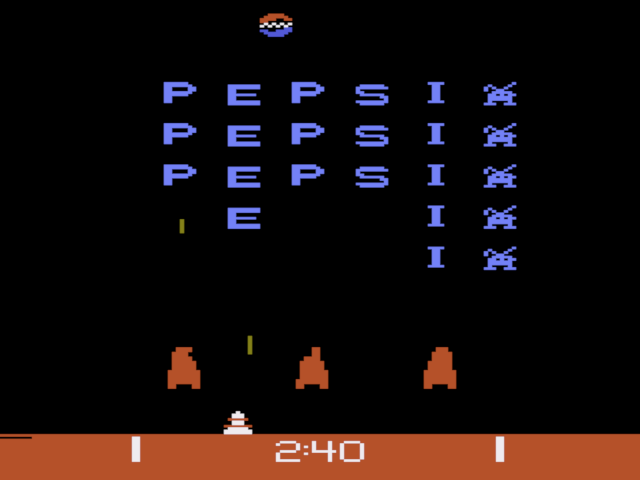 One game that was corporately sponsored, but still worth a look is Pepsi Invaders for the Atari 2600! This cute and amusing title was never made available to consumers. Instead, it was commissioned by Coca-Cola and handed out to their salespeople at a convention. In this game, you must defeat the evil Pepsi logo and his wicked henchmen, in order to remind everyone why Coke is better! Though it’s described in many places online as a simple sprite hack of Space Invaders, it doesn’t have the same game modes and the code has clearly been heavily modified too. Nowadays, the game is greatly sought after by collectors since only 125 copies were ever produced.
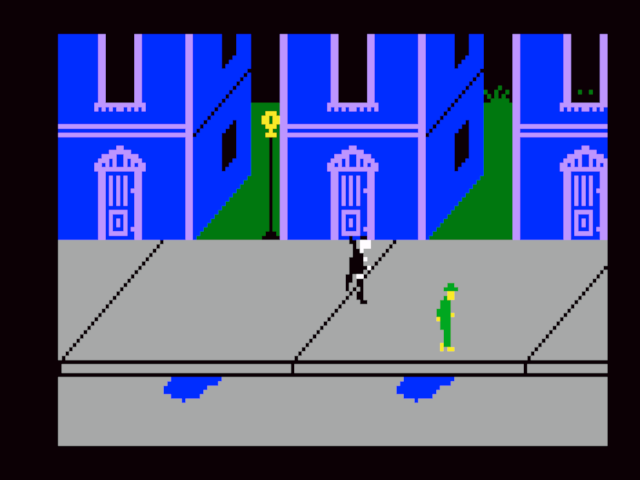 If drinking Coca-Cola is not your speed, maybe you’d prefer to drink blood instead! 😃 That’s what you get to do in Dracula for the Intellivision as you prowl the streets as a vampire, feeding on helpless victims! The concept is extremely cool, and the colorful graphics do a good job of giving the neighborhood a fun, super spooky feel that makes this the perfect game to spend some time on every Halloween, which I very much plan to do going forward! 🎃
The only downside is that it can be a bit complicated to figure out on your first play. Don’t be intimidated! Just do the easiest difficulty and walk around the neighborhood. Go after people you see out on the street (either bottom action button on the controller bites). If necessary, try to knock on doors by bumping up into them to lure people out into the street to get them too! Once the white wolf shows up, that’s your cue that you’ve found everyone and it’s time to head back to the graveyard before the sun comes up. You can freely become a bat at any time (either top button to toggle forms), which allows you to move much faster and leaves you invulnerable to most dangers. To keep you from doing this too much though, a purple vulture will show up who can carry you away and end the game! If he catches you, you have to shift to human form again to get rid of him! After two nights, local law enforcement will realize they have a problem on their hands, and the neighborhood will be patrolled by police. While you can defeat them by turning someone into a zombie and using them to attack, this is a big procedure that requires the use of the second hand controller, and it’s probably easier to just avoid the officers as they are quite clumsy and slow. And yeah… that’s pretty much the game. Being dead has never been a more interesting experience! Give it a bite! 🦇
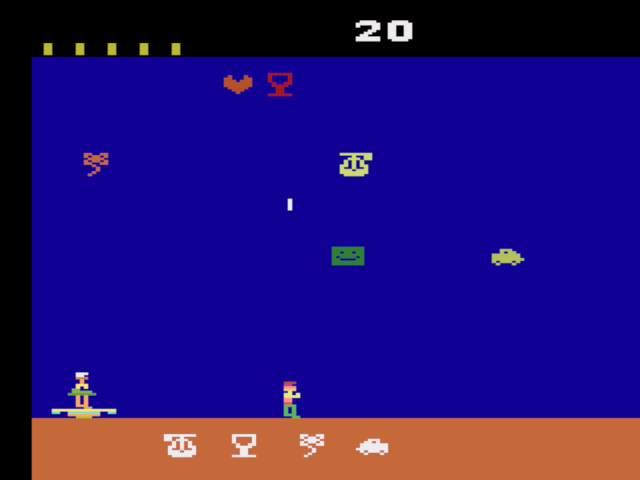 There are more innocent things to want from people than blood, as portrayed in Pick Up for the Atari 2600! In this game, you have to win the affections of a cute girl by offering her gifts! The gifts are moving in the sky, and you shoot them to collect them. You can do this in any order, but the idea is to not offer the same gift more than once, so you have to make sure your bullets don’t hit a gift you’ve already collected! If you manage to get all the gifts, you get to take the girl to a hotel and… umm… not drink her blood! One really fun element to this game is how you can use the first difficulty switch to swap the characters, for people who want to play as the girl winning the affections of the guy! It’s always nice to see the rare game that doesn’t subconsciously discourage females from playing! 🫠
Sadly, this game wasn’t actually released at the time, being one of many unsold prototypes dated to this year as a result of the Great Video Game Crash of 1983. It’s such a shame – the brutal condemnation of this year by the consumer market meant so many unique ideas would never come to light. 😢 It wouldn’t be until 2002 that Pick Up was finally made available to the public, and I’m glad it was! At last, closure!
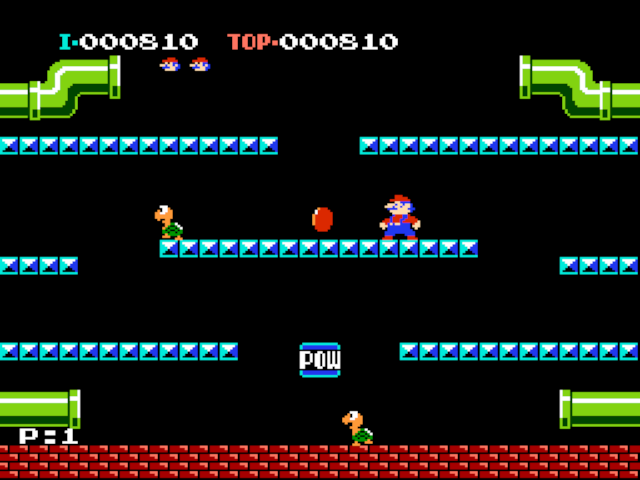 One game that certainly had no problem getting released and attaining widespread commercial success was Mario Bros., an arcade game that was also made available for the Famicom (pictured), Atari 5200, and Atari 2600 the same year (though some sources have the Atari 5200 version instead coming out early in 1984). Mario Bros. is a historic first in introducing Mario’s brother, Luigi to the franchise as the second player as well as making Mario into less of a villain than he was in the Donkey Kong series. The two Mario brothers are working the sewer systems in New York when they come across a whole pile of monsters hidden down there! While later Western media made the connection that this is how Mario and Luigi eventually discover and enter the Mushroom Kingdom featured in later games, nothing of the sort is actual canon in the original series.
In any case, Mario Bros. has you defeating monsters that come out of the pipes by jumping up against the platform beneath them, causing them to temporarily flip upside down and enabling you to finish them off by touching them! Once you have defeated all of a round’s enemies, you move on to the next! The game slowly introduces new enemies, including crabs that need to be bruised once before they will flip upside-down, jumping, fluttering arthropodal-type creatures that are hard to stun because they are only sometimes actually touching the ground, and anthropomorphic piles of snow that melt and turn platforms into a slippery mess if you fail to stop them in time! Once all the game’s content has been introduced, you stay in ice-themed levels and the game just repeats at a higher speed. Throughout the game, very annoying fireballs are deployed from nowhere to keep you from camping in one place for too long!
While the Atari 5200 version and especially the Atari 2600 version are substantially scaled down, the Famicom version only barely looks worse than the arcade release and contains all the same gameplay elements except for the falling icicles that appear in later rounds in the arcade release.
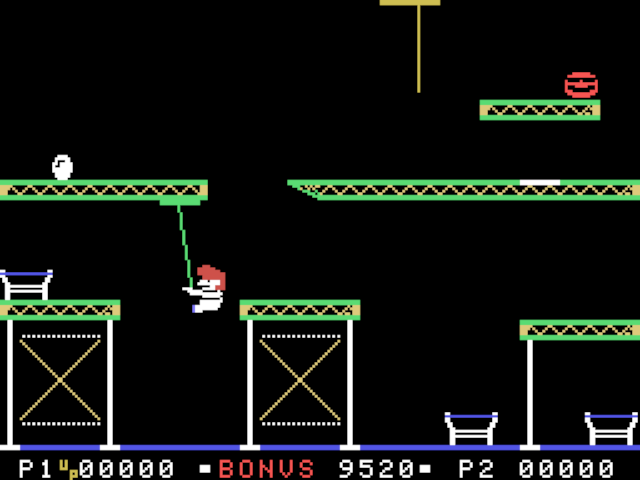 Mario Bros. continues forever with no real resolution, as do most games at this still-early stage of console gaming history. But as with earlier years, there are still some completable games to be found if you search for them. One such game is Sammy Lightfoot, which is yet another example of a platform game before the formal concept of platform games really existed, made possible in this case by the premise of being a circus performer! Sammy has a number of different one-screen levels to get through before the game is “finished”, although you can continue on with a harder version of the game to keep acquiring score if that’s how you want to do it! Not that you’ll make it that far without cheats, because Sammy Lightfoot is VERY tough. It’s all about timing, starting your jumps at the right second in order to make sure the enemies don’t get you at moments where you don’t really have an opportunity to get out of the way. It’s not perfect, but still fun, and I think it’s worth giving it a shot!
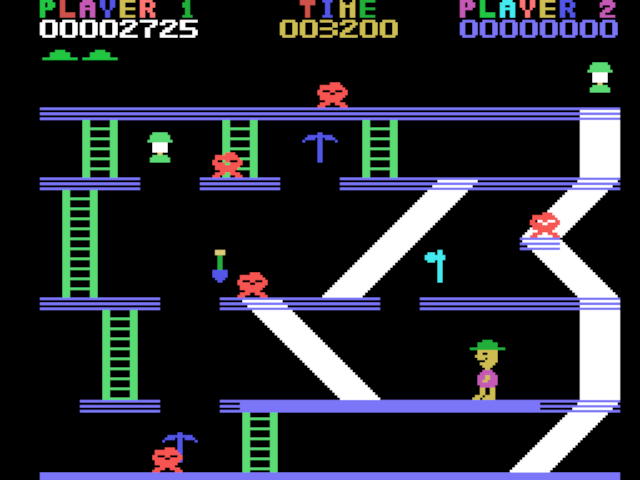 Another interesting platformer is Miner 2049er. Better known as a game for Atari 8-bit computers and a number of other home computer systems, Miner 2049er was also ported to three consoles this year: the ColecoVision (pictured), the Atari 5200, and the Atari 2600. Borrowing concepts from both Pac-Man and Donkey Kong, this game has you walking along every platform in the level until all of them turn solid. There to get in your way are monsters that can be killed by picking up items that temporarily turn you invulnerable, and a very, very harsh timer that forces you to strategically plot out the most efficient order in which to do everything. This game is very tough and frustrating on its own, but with infinite lives and infinite time cheats I very much enjoyed exploring the levels and defeating the baddies! 🙂 The game has an uncommon feel for a console game that is probably because computer games at the time had a different focus, being more complex and involved than the casual pick-up-and-play style of most console games of the early 1980s.
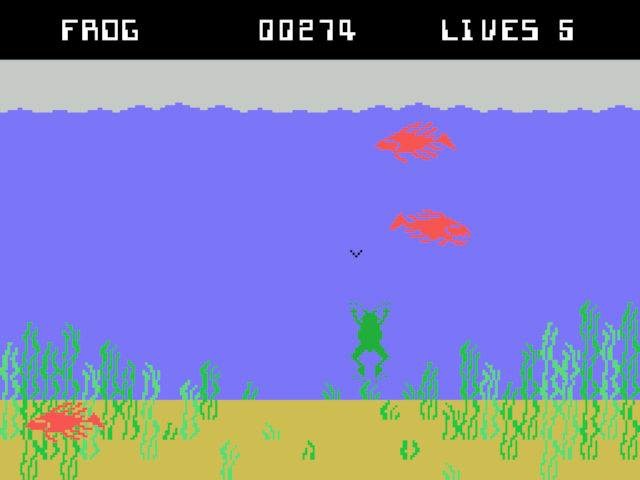 I’m not sure if Evolution for the ColecoVision should be considered completable or not, since it doesn’t take particularly long to get to the end before it repeats and you continue to acquire more score. Either way though, it’s certainly a very creative and unique concept that deserves attention! This game is several games in one as you progress from a lowly amoeba to what is naturally the pinnacle of evolution and totally not full of itself for thinking so at all – the homo sapiens! This game is one of the few games that managed to trigger an emotional reaction in me in a way that suggests an emerging form of high art, with a somewhat unsettling surprise when you get to the human game at the end of a run – something that made all the earlier segments feel like they portrayed more innocent, happier times. I won’t spoil it for you! Go play it! Now!
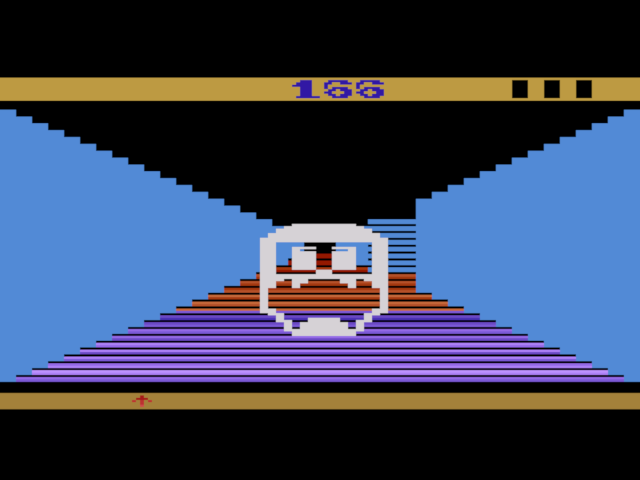 Another game that got me emotional, albeit in a different way, was Tunnel Runner for the Atari 2600. This unique game, made possible by a memory expander add-on for the console, has you exploring a maze, trying to find the key you need in order to escape. You share the maze with bizarre, surreal monsters. If none of that sounds all that unique, that’s because it isn’t. What makes the game special is that it is played from a 1st-person perspective! Goofy music plays to let you know when one of the monsters is nearby and there is something artistically noteworthy about the fun panic the game makes you feel when you hear that music and know that one of the monsters is coming! Making the music sound silly and fun rather than genuinely scary doesn’t take away from the fear factor, and only causes the whole thing to feel more sadistic and chaotic.
I absolutely love this game, but it’s not without its problems. I did have one time where I spawned at the end of a long-dead end with a monster already headed towards me and there was nothing I could do but die. 😑 Still, that only happened once, and that one moment of frustration was worth the rich experience the game offered me!
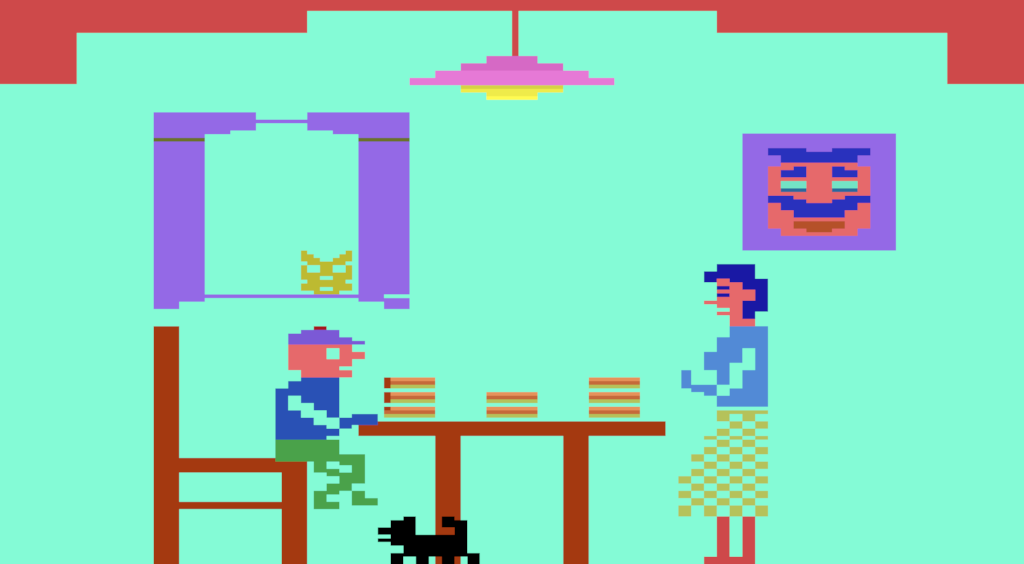
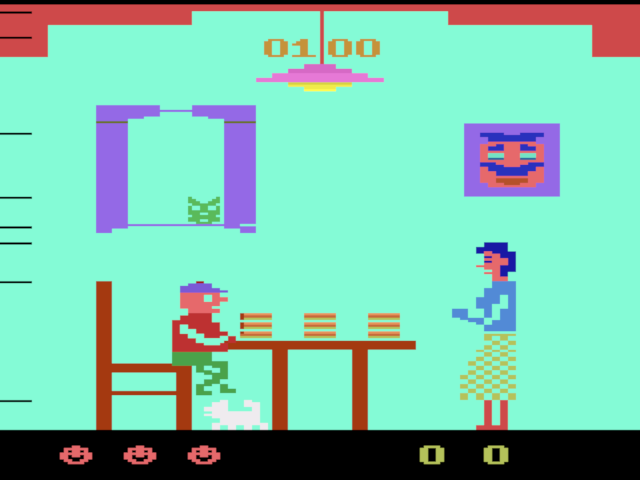 No game has ever made me feel weirder though than the odd mix of mirth, horror, nausea, and disgust I got from playing Mangia for the Atari 2600, which I think is easily the most special game released this year. Certainly, it is by far the strangest! In Mangia, you play a boy sitting at the supper table as “Mama” makes him a rather excessive supply of pasta to eat. You might not be nearly so hungry, but Mama is very insistent that you eat all the food she worked so hard to cook for you because of how much she loves you! The problem is that if you just do as she asks and continue to eat, eventually, your stomach will explode from all the food and you will die! And if you just let all this pasta pile up on the table, the table will collapse, which is also considered a failure! This is where Sergio the dog and Frankie the cat come in. They’ll eat some of the pasta for you if you throw it to them! 🫡 But if you miss, or you do it while Mama is watching, she’ll realize what you did. Her feelings will be hurt and the game will punish you by multiplying the next helping of pasta you need to eat! So you’re only able to do this when the timing is right, and there are going to be times where you just have no choice but to eat some of the pasta yourself! The game is divided into rounds, with the number of plates of pasta left to be served for the current round shown in the bottom right corner of the screen. If you can survive to the end of the round, you can continue to the next one with an empty stomach again, presumably because the next round is a new day. Each round is harder with Sergio and Frankie appearing less often, faster delivery of new plates of pasta, and more plates to deal with overall in order to survive to the next round!
I’m not sure what lead to the creation of this game or what the twisted genius responsible for it was thinking when they created it. It’s clearly designed to poke fun at Italians, both because “Mangia” is Italian for “eat” and because of the stereotypical Italian melody that plays at the start and end of each session. But I have plenty of non-Italian friends who can relate to the parody of a mom who is just a bit too eager to make sure her kid is well-fed and in that way the game helps to surface the common humanity of people. Sadly, Mangia would not be on the market for long before the Great Video Game Crash of 1983 would take it out of stores! ☹️ It’s a rare find these days because of the relatively few cartridges of it that ended up being produced when compared with most other games. Thanks to the power of the Internet though, anyone can now easily be treated to just a taste (or much, much more than that) of its dark humor! Please check it out!
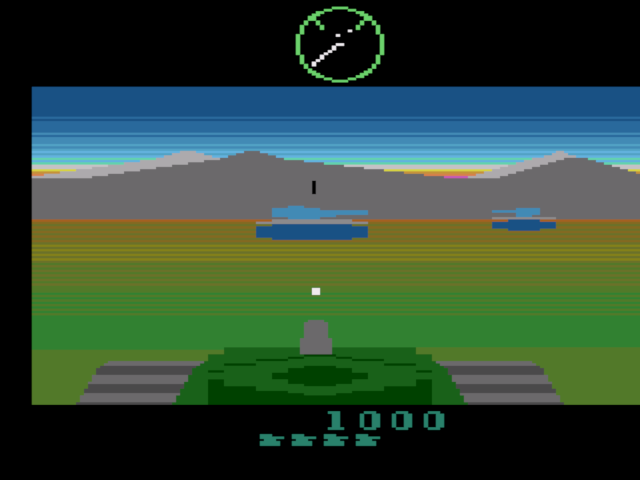 The year 1983, with its unfair reputation, is filled with console games that are great from a gameplay standpoint as well as from an artistic standpoint, but there are also games that are interesting from a technical standpoint as well! One thing that really surprised me is the sheer number of 3D games that were available in such a primitive time and for such primitive consoles. Tunnel Runner might have required a special hardware add-on to achieve what it did, but this was not the case with Battlezone, an Atari 2600 port of the 1980 arcade game of the same name. Making such a sophisticated arcade game available on 3-years-older home console hardware was surely not an easy task, but it seems like it was managed elegantly. I am particularly impressed by how they used the technique of changing sprite colors as the screen is redrawn to make your tank appear to be moving as the stripes along its belted wheels cycle. The illusion of 3D is maintained without the original arcade version’s seamlessly scaling vector graphics, even if you have to squint through the “fog” of the overly simple visuals at times. The concept of this game was duplicated by Activision with their “Robot Tank” game, which introduces some unwelcome complexities around driving with a damaged tank, and a much better effect on the ground that leads to a stronger illusion of moving forward as you explore the area, searching for targets. An Atari 5200 port of Battlezone was created as well, but exists now only as a prototype as it was never released!
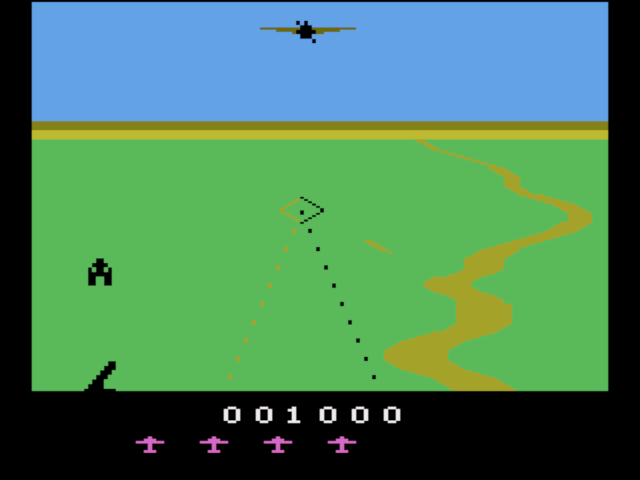 Perhaps an even better example of a surprisingly believable-looking 3D environment on the Atari 2600 is Spitfire Attack. In this game, you fly through the sky in a fighter plane, attacking both targets in the air and on the ground that all want you dead! The roads you see stretching into the horizon contribute a lot to a feeling of detail as you move seamlessly forward. The game even adds a sense of altitude – if you point your nose downward in order to aim at things on the ground too much, you’ll be too low in the sky and risk crashing into the ground! As far as the gameplay – it isn’t the most amazing thing since sliced bread, but it’s good enough to give you something to enjoy the visuals with. 🤷🏻♀️
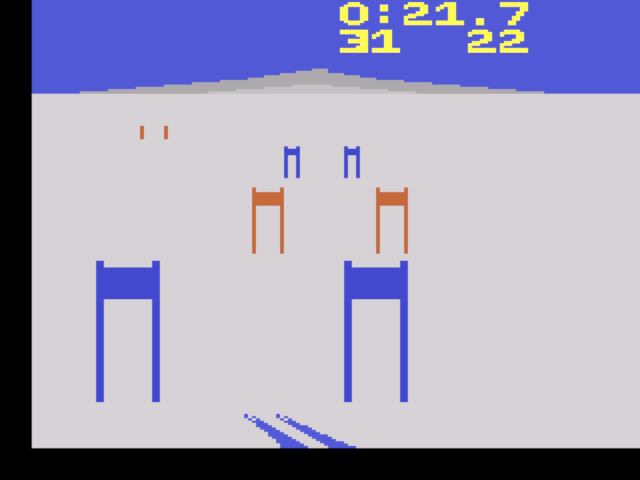 Technical innovations go well beyond simply making the games 3D, as can be seen with Mogul Maniac for the Atari 2600. Mogul Maniac was also a 3D, first-person game, but what really made it special is the unique controller it came bundled with, called the Amiga Joyboard! This immersive experience allowed you to aim your way through the slalom gates by leaning on the board, though the game could also still work with a standard Atari joystick if you were feeling boring. The game itself could maybe be more interesting, and seems to largely serve as a demo for what the technology can do. It’s a shame no other games were made for the Amiga Joyboard! There were some prototypes in the works, including a surfing themed game that sounds like it would be pretty cool, but none of it ever came out, presumably because of the Great Video Game Crash of 1983.
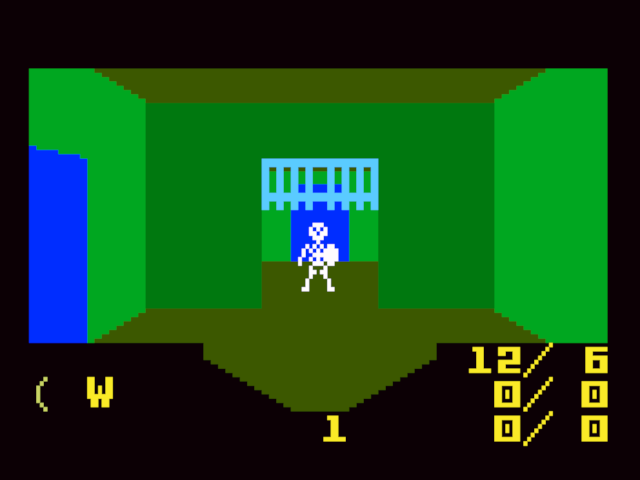 Advanced Dungeons & Dragons: The Treasure of Tarmin for the Intellivision doesn’t come with any special hardware, and its 3D environment doesn’t offer any kind of smooth camera movement. It’s still interesting though just because of how complex and involved it is! Out of all the games I played for this year, I probably spent more time on it than anything else. The gameplay is very similar to a roguelike dungeon crawler game, where you explore floor after floor of a long dungeon, collecting randomized items and engaging in combat with enemies, only the game is played in a 1st-person view!
Unfortunately, it’s one of the few Intellivision games I found this year that still makes extensive use of the numeric keypad during play, and the game’s items and mechanics are complicated enough that you really need to read the manual – it’s just not possible to drop into the action and figure it out on your own. Combat can be annoying too as it has you constantly scrounging around for temporary things to attack with rather than being able to take a permanent arsenal for granted. The game balance is rather poor as well – there’s an item you can find through random chance for example that grants you the ability to walk through walls, enabling you to procedurally sweep each floor and clean it out with no real sense of exploration left. All that said, I do think the game is worth a quick look if you want to see what such an early year in gaming history is really capable of!
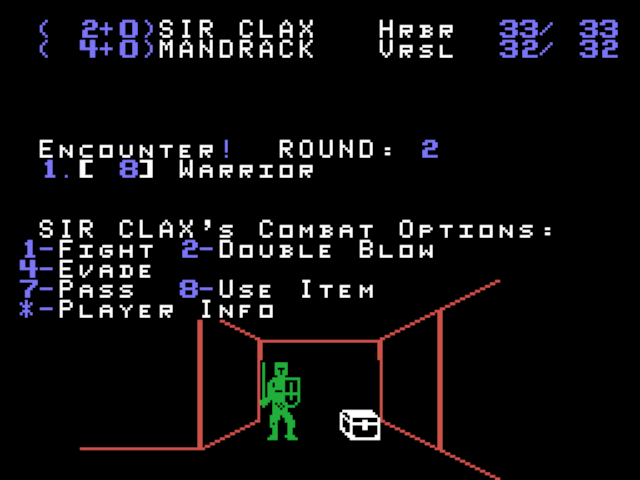 One big issue with Treasure of Tarmin – and the reason why so few console games in those days were so involved, is that there is no means of saving your progress. If you want to do something else with your Intellivision, you have to shut the unit down and lose everything! This is not a problem had by the similar game Lord of the Dungeon for the ColecoVision, which has the claim to fame of being the first console game ever released to include battery save support… or at least it would have if it had actually been released! The problems began with the manufacturing phase, where reliability issues with the battery-based save technology on the cartridge caused significant delays. The project was then killed completely thanks to the Great Video Game Crash of 1983! ☹️ The fact that such save technology had been developed however – a full 4 years before it would be popularized with Nintendo’s North American release of The Legend of Zelda – is still quite interesting, especially with how incredibly limiting it is to be without it.
While the mass-manufacturing of the hardware never happened, the software was apparently quite complete, and a finished prototype of the game was eventually made available to the public in 2001! Apparently, the save feature was used to preserve your characters and their stats across play sessions, rather than to actually save your progress in the middle of a dungeon. But I can only read about it and can’t verify that for myself, because I’m just unable to figure out how to actually play this thing! 😵💫 You start off in a tavern, where you are supposed to create the characters you will use, and I simply can’t figure out how to navigate the menus properly. It was only by a miracle I was able to actually get past that point and get into a dungeon at all, with no one but the two default characters. From there, I quickly got my little demon bum handed to me by a common trash mob and that was that! 🪦 I’d hoped the Internet could help, but it doesn’t look like anyone else has gotten much further than me with it. I couldn’t even find a good longplay video to show me what the game is actually like. This was easily the most frustrating experience I’ve had with this entire project, but I guess it is what it is! 😢 Maybe someday I’ll be able to figure this out and give it a whirl. At the very least, I felt it was much too important to go unmentioned on this page!
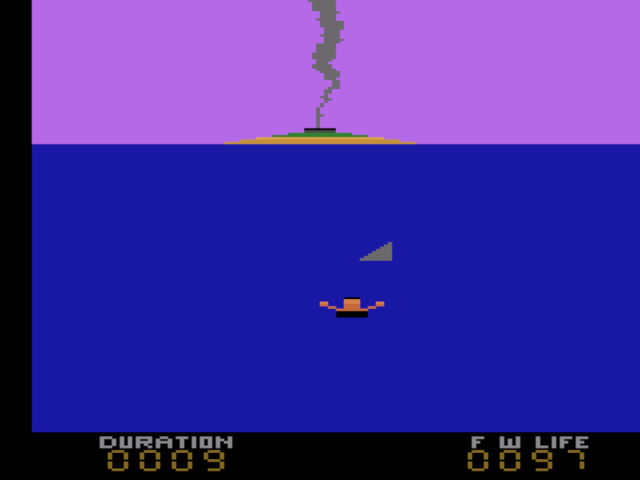 Thanks to the tragic cancelation of Lord of the Dungeon, this was not the year battery-based saves were introduced into the console gaming world. We still had save support of a kind however, thanks to the successful, albeit mail-order-only release of Survival Island for the Atari 2600, which is also the last game to make use of the Starpath Supercharger addon! While there was no permanent save data that was actually stored anywhere in the system, Survival Island utilized a password-based save technique that would be a popular substitute for true save support in many future games starting several years later! Rather than enabling you to take a break and come back later, the password save feature in Survival Island was included as a workaround for a serious hardware limitation – the game was so big that it couldn’t all be loaded into memory at once! Instead, it was divided into three separate stages. When you completed one stage, memory needed to be totally cleared out to load in the next stage. The only way to save your progress was to display a password on the screen that the game code for the next stage could then read in order to preserve your items and status. This design meant that you couldn’t actually save whenever you liked. Instead, you had one chance to save at the end of stage 1, and one more chance at the end of stage 2. That’s it. And the game was more than long enough that you were going to be forced to leave things running overnight in order to finish. 😬
Each stage was like a completely different game, sharing none of the graphics or gameplay from other stages. In the first stage, your ship has sunk, and you are traveling on a raft to the mysterious island, struggling to recover what supplies you can and avoid sharks and other hazards along the way. Stage 2 is by far the longest and most involved stage, where you have to navigate the huge, open-world space that is the island, relying on the supplies you recovered in Stage 1 to survive. Your ultimate goal is the mysterious temple on the island’s highest peak, the interior of which is Stage 3, where you are navigating a 3D maze in first person view.
I really gave this game an honest shot – I really did. I completed Stage 1 easily and spent quite some time fighting with Stage 2. But the island was just so huge and daunting, and the gameplay so brutally unforgiving and unfair, that I really had to step back and ask myself what I was doing. While it doesn’t happen often and I try my best to experience all the content of every game, I’d said from the start that I was allowed to limit myself to just exploring a title for a few minutes if it wasn’t something I found fun, or something that would be just too much effort to learn all about in order to play. This is something I’d already been doing with some ball sport and playing card games, and I didn’t think much of doing that. But those games didn’t entice me like Survival Island did – I love the mysterious island cliché in games! 🏝️ It was a very difficult decision, but in the end I decided that what this game was asking of me just sounded too miserable, and that misery would have consumed nearly all my time for weeks or even months! So instead I just watched a YouTube video of someone playing it. 😐 I think that is definitely the best way to experience it. I can’t say it’s actually a good game, but it’s still interesting to read about with what an incredibly ambitious project it was, and the implementation of a password save feature does herald an era of much longer and more complex games that would arrive a few years later!
Meanwhile, in Arcade Land…
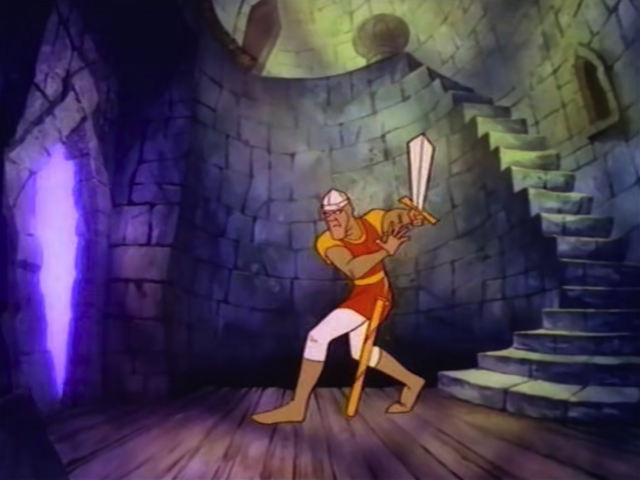 Arcade games continued to evolve graphically, even as gaming consoles seemed to be bumping up uncomfortably close to their capabilities. This year I’d say maybe half of the arcade games looked about as sophisticated as Famicom games, albeit with a higher resolution and better quality sound effects. The other half looked about as good as the Sega Master System / Mark III that wouldn’t be coming out for another 2 years. With the graphical experience otherwise looking so much better, I started to really notice and get annoyed by the popularity of the vertical 3/4 aspect ratio, which left the games feeling claustrophobic and not nearly as immersive as they could have been. It sounds though like this is the peak of that trend and the situation starts getting much better in 1984!
As for a specific game to spotlight, I’m going to have to go with Dragon’s Lair because it is just such a fascinating concept! A common misconception about this time period is that everyone thought the graphics of video games were perfect and that they couldn’t conceive of something better. That’s not true! The people back then dreamt of having something like an Xbox Series or a Playstation 5 – they just knew that wasn’t possible yet! 😢 As a radical solution to the problem, a handful of arcade games employed an absolutely fascinating workaround called the “laserdisc”, where an actual animated or live action video became the basis of a game’s graphics. For titles like Dragon’s Lair, this footage made up 99% of what you saw on the screen. Gameplay consisted entirely of what we would today call “Time Attack” cutscenes that was the arcade unit skipping to specific spots in a video that depicted your character succeeding or failing at specific obstacles based on how well you were doing pushing the right buttons at the right times. Other laserdisc games would use video footage as a background and draw conventional graphics – maybe a flying ship you moved around in and enemies and missiles and so on – on top of it. The concept was incredible and lead to some unique experiences! Unfortunately, laserdisc games were also notoriously unreliable. The laserdisc reading equipment just wasn’t built to handle the constant whiplash from skipping back and forth to different parts of the video – at least not nearly that often – and it meant they broke down quickly. 😬 Still, the technology would become more practical with time, leading to a renaissance for the concept on home video game consoles in the early-to-mid 1990s!
Other than the introduction of laserdisc games, I wasn’t really that impressed with 1983’s arcade machines in the innovation department. Most of the releases were simple shooters with some maze games thrown in and with very few exceptions, such as Mario Bros., I didn’t see much that was all that interesting or revolutionary like I had with previous years. 1983 is widely considered to be the final year of the “Golden Age of Arcade Games” and from this point on, the medium experiences a gradual decline in popularity. Console games would die off much faster though as a result of the Crash, so we can expect arcade game releases to once more outnumber console game releases for the next few years of this project. 🙁
Conclusion
During the long trial of plodding through 1983, I actually gave up at one point! I am so glad I got back on the road and continued! This has been such a magical and rewarding experience that has been worth all the time I’ve put into it! 🥲 And now that I’ve finally broken past the deeply intimidating wall that was 1983, 1984, 1985, and even 1986 should be a breeze! I should have an article for 1984 out in just a little over three months if all goes well! Stay tuned! 🫡
yay